Planetary nebula
M27 Dumbbell Nebula with a Seestar S50
The raw stack on the left, auto-stretched; the image Stelora finished from it on the right. Drag to compare.
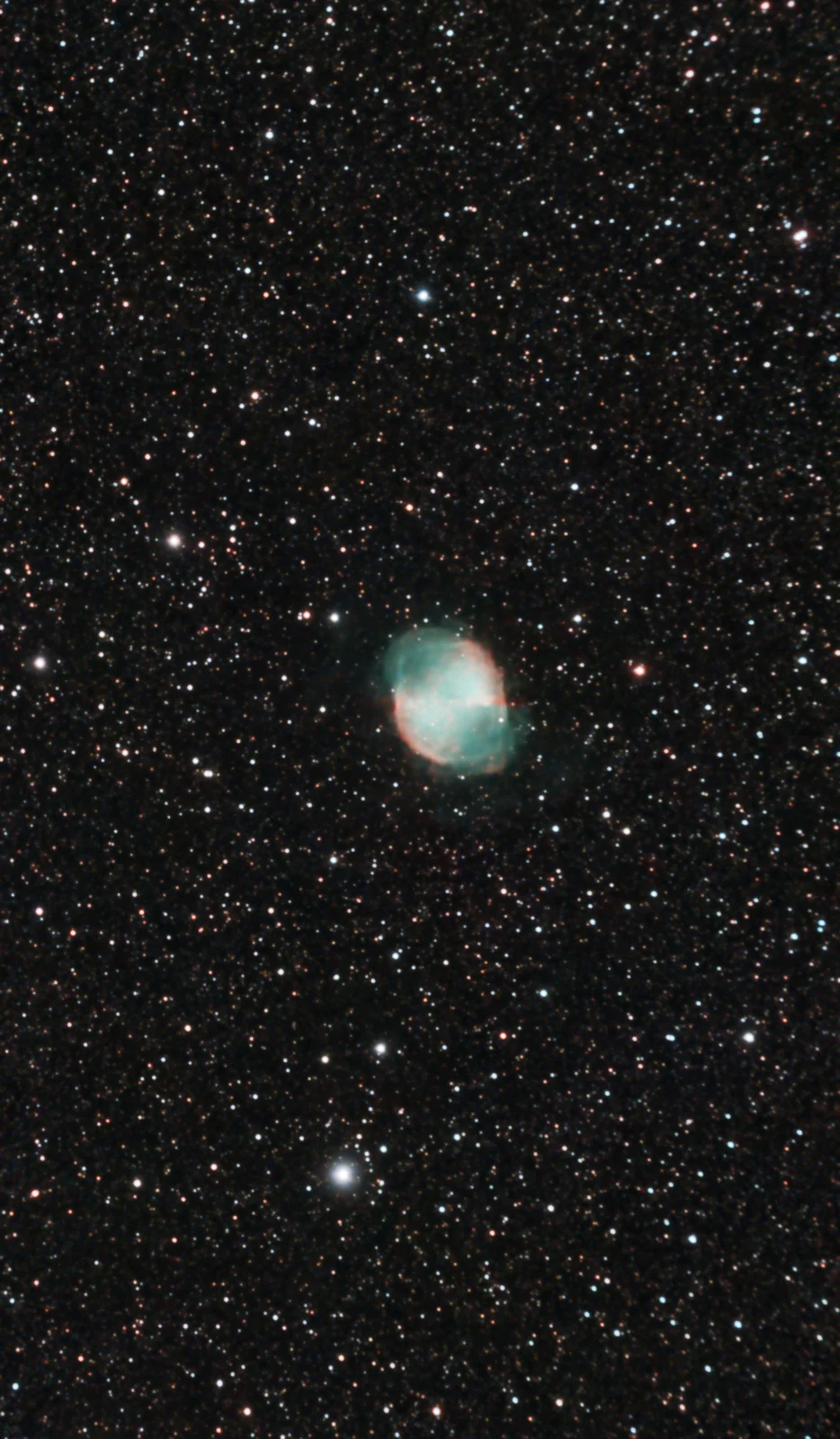
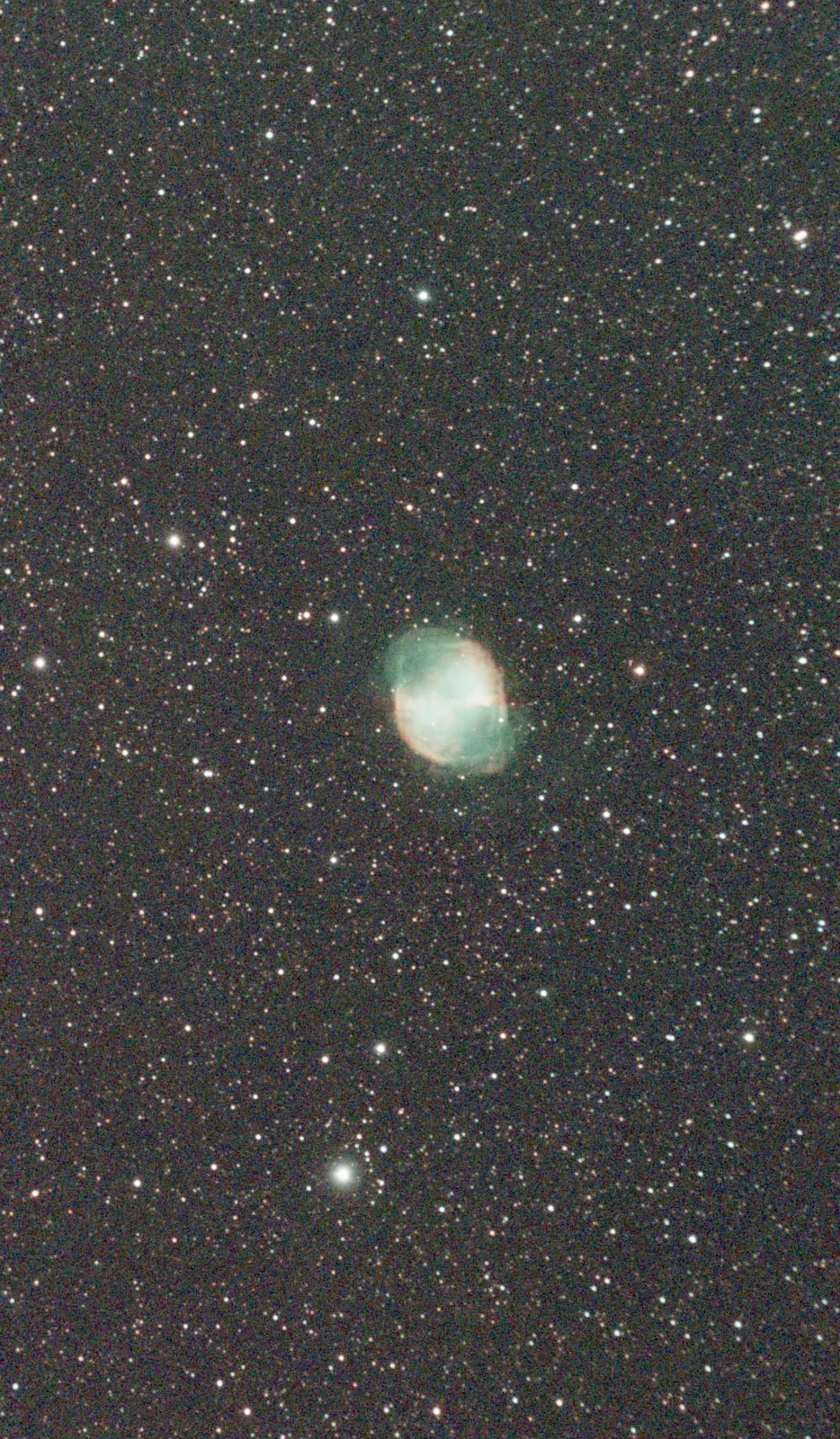 Raw, auto-stretched Finished
 - Telescope
- Seestar S50
- Frames
- 411 × 10 s
- Total integration
- 1 h 9 min
- Stacking
- Raw subs, stacked by Stelora (411 of 432 kept)
- Processed with
- Pipeline 0.10.0
- Data
- Cyril D.
About M27
The Dumbbell Nebula is a planetary nebula: the shell of gas a dying Sun-like star threw off, lit by the hot white dwarf left at its centre. It lies in Vulpecula, about 1,200 light-years away (estimates range from about 1,100 to 1,400), and it was the first planetary nebula ever found, by Charles Messier in 1764.
It is a summer and early autumn target in the northern hemisphere, inside the Summer Triangle of Vega, Deneb and Altair.
At magnitude 7.5 it is bright for its kind, but small: about 8 by 5.6 arcminutes, a small patch in the middle of a Seestar S50’s 1.3 by 0.7 degree field, as the full frame here shows. Most of its light is hydrogen-alpha (red) and doubly ionised oxygen (blue-green), the two lines the Seestar’s dual-band light-pollution filter lets through. Under a light-polluted sky, that filter keeps its contrast.
Not sure where the file is? Where your Seestar or Dwarf 3 saves its FITS files.